









Commemoration
 AIA Dig. ID 0031PL03 |
|
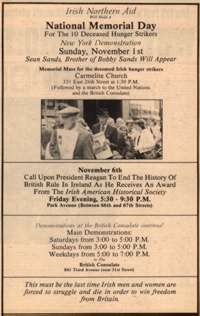
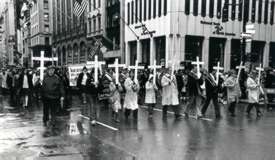
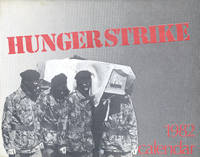
"Last Sunday Irish Northern Aid held a commemoration
in New York for the ten deceased hunger strikers…
It was filmed by the NBC television network, Canadian
Broadcasting Company and local CBS news… Sinn Fein
Councillor Frank Glynn from Galway then addressed the
crowd and spoke about the impact of Americans in
winning the hunger strike victory… The march then
turned toward the British Consulate where it ended
with the singing of the Irish and American national
anthems."
"Commemoration"
Irish People, 7 November 1981,
2
 AIA Dig. ID 0003PL01 |
 AIA Dig. ID 0039PL02 |
 AIA Dig. ID 0027PL04 |
|
 AIA Dig. ID 0043PL02 |
|
|
|
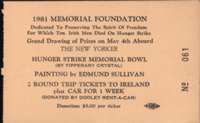
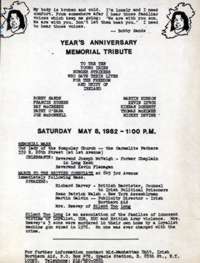
"Brian O'Dwyer, chairman of the event, started the formal proceedings
off with a rousing speech about how the Irish weren't prepared to put
up with any more discrimination at the hands of the British. The crowd
then became silent when Nassau County Comptroller Peter King called out
the names of each of the hunger strikers, and a bell tolled after each
name."
"Hunger Strike Cruise
Strikes Gold"
Irish Voice, 11 May 1991,
26
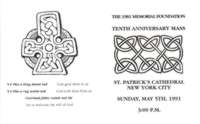
"And so it went yesterday, 10 names in all, the 10 Irish Republican Army members who died 20 years ago in a hunger strike at a prison in Northern Ireland, recalled in a somber service as heroes and martyrs for Ireland.
The widow of Mr. Sands...expressed gratitude for the turnout, which was said to be among the largest since memorial Masses for the hunger strikers were first held in the early 1980's...
Larry Downes, president of the Friends of Sinn Fein Organization, said
the hunger strike in 1981 changed Irish history by giving inspiration
to the Republican political movement and educating people around the world
about the Republican cause. 'It was the springboard for the current peace
process,' Mr. Downes said."
"Mass Honors 10 in I.R.A. Who Starved"
New York Times, 11 March 2001,
40
 AIA Dig. ID 0038PL02 |
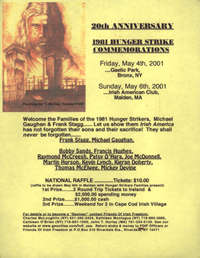
"Whatever their policies, everyone in Northern Ireland agrees about one thing: that the 1981 hunger strike, during which 10 republican prisoners died, was a watershed. [Their] deaths changed the politics of the conflict forever…
The rise of Sinn Fein as a political party, and the decline of the IRA as a guerilla army, can be traced directly to their tragic protest…
[Margaret Thatcher's] obstinacy helped ensure that Sinn Fein would become a political party that in the 20 years since the hunger strikes has grown in popularity and strength and is now threatening to replace the Social Democratic and Labor Party as the voice of Northern Ireland nationalism…
During that period of political growth, Sinn Fein drew resources away from the armed struggle, eventually replacing the IRA as the main engine running the republican movement.
 AIA Dig. ID 0019PL02 |
The hunger strike led to the rise of Sinn Fein, which in turn helped to bring the British and Irish governments closer together in an attempt to undermine the growing support for the IRA's political wing. It had convinced the British that the Northern Ireland conflict could not be solved by Britain alone. The Anglo-Irish Agreement was one outcome. The very peace process itself, it could be argued, was the other. That process would be meaningless without Sinn Fein, and Sinn Fein would not exist as it does today without the events of 1981.
The goals of Bobby Sands and his comrades were limited and specific:
the return of special category status. The goal of Margaret Thatcher was
more ambitious: the criminalization of the IRA. She failed. They succeeded.
But their success, in the end, has made the IRA redundant. That will be
their lasting legacy."
"Hunger Strike Legacy"
Editorial, Irish Echo, 2-8
May, 2001, 10
|
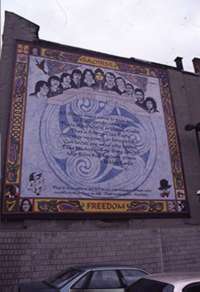
"When the mural by Tom Billings and Gerard 'Mo Chara' Kelly goes up in East Harlem on Saturday 5, there's bound to be some controversy. The painting commemorates the 20th anniversary of the 1981 Long Kesh Prison hunger strikes, in which ten IRA activists—or terrorists, depending on your point of view—starved themselves to death, in protest for being treated as criminals instead of prisoners of war.
The 30-by30-foot image—digitally transferred from an eight-foot-square
canvas onto the same meshy material used for Gap or Kenneth Cole building
ads—depicts the ten strikers above a quote from Sands's writings:
'There is no source or foreign force can break a man who knows, that his
freedom nothing can kill, and from that freedom grows.' Tucked into the
corners of the painting's Celtic-patterned borders are images of four
Irish civil-rights activists (Frank Stagg, Michael Gaughan, Nora Connolly
and [Mairead] Farrell), as well as four international icons: Nelson Mandela,
Leonard Peltier, Martin Luther King Jr. and Mahatma Gandhi. 'In order
to break down the isolation of our situation, I decided that we should
identify with other people,' explains Mo Chara. 'So you have four international
figures who are basically in the same position: We have been conquered
and occupied.'"
"Gael force:
On the 20th anniversary of the
hunger strikes, two muralists hit
the wall in
East Harlem" by Billie Cohen
Time Out New York, 3-10
May 2001, 57