









February - May
"Only the the loud voice of the Irish Republic and world opinion can
bring them [the British government] to their senses and only a hunger
strike, where lives are laid down as proof of the strength of our political
convictions, can rally such opinion, and present the British with the
problem that far from criminalising the cause of Ireland their intransigence
is actually bringing popular attention to that cause."
IRA Blanketmen statement
Irish People, 14 March 1981, 1
"The magazine section of The New York Times of Sunday, March 1st
contained an article on terrorism. Its basic theme was that there is an
international network of terrorist organizations supported and trained
directly or indirectly by the Soviet Union for 'the destabilization of
Western democratic society.' One organization singled out for particular
attention was the 'Provisional' Irish Republican Army. References to the
situation in Ireland were clearly designed for anti-Irish propaganda in
America: the errors and untruths would be too obvious to Irish readers.
Throughout the article there was a deliberate effort to assign to the
anti-Marxist Provisional IRA the views and activities of the pro-Marxist
'Officials.'"
"Oisín"
Irish People, 14 March 1981,
6
"Since the start of Sands' self-starvation, The New York Times
and The Washington Post have explained Sands' imprisonment only
in terms of convictions for 'illegal possession of guns.' That may be
technically accurate; it is not informative. Although it taints the melodrama,
it is well to remember that Sands is a terrorist."
"Broken Window-Pane
Politics," George F. Will
Washington Post, 30 April
1981, A-35-1-P
"The mini-invasion of foreign journalists attracted by the threat of
bloody rioting came in for stern criticism by the Protestant minister
who buried Gary Martin, a police constable killed by a bomb planted in
a booby-trapped truck Monday… 'The world's press,' said Rev. Donald Watts,
'…may be fascinated for a time by those able to manipulate it for their
own ends and by those who fly in and out of the province to make easy,
facile statements.'"
"Sands' hunger strike
and the fate of Ulster"
Boston Globe, 1 May 1981,
9
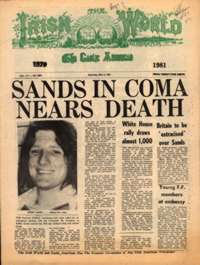 AIA Dig. ID 0034PL03 |
"The primary aim of the fast is not simply political status, but the
international publicity."
Washington Post,
3 May 1981, 2-3
"I'm a bit cynical about the international press. It only comes here
when there is a smell of blood, not when the patient work is being done.
All this international attention gives the Provos [outlawed Provisional
Irish Republican Army members] a big lift. People get on bandwagons."
John Hume, Social Democratic
and Labor Party
Washington Post, 4 May 1981,
A-23-1
"If over the next few weeks or months there are acts of terrorism against
British officials in America, a deal of responsibility will rest with
the disgraceful and unbalanced coverage the U.S. media - especially TV
- have given to the death of Bobby Sands. In all the outpouring of indignation
and emotion, the American media have given nearly exclusive coverage to
pro- I.R.A. spokesmen. Not a word has been heard from the many moderate
critics of the I.R.A. The Rev. Ian Paisley, the Ulster extremist who is
an apologist for Ulster vigilantism and the terrorism of the other side,
has been portrayed as somehow representative of critics of the I.R.A.
This grotesque picture is sheer I.R.A. propaganda."
Peter Samuel, Letter
to the Editor
New York Times, 7 May 1981,
34
"Saying 'I stick by my story,' a New York Daily News columnist resigned Friday after the British army in Northern Ireland charged that an article he wrote about the riots after the death of Bobby Sands was a 'complete fabrication.'
Michael Daly, 29, had come under attack earlier in the day when the London Daily Mail charged that his story was 'a pack of lies.'…
The Mail said Daly's article from Belfast was 'a malevolent piece
of lying propaganda.' It accused the United States news media in general
and the Daily News in particular of 'spearheading a campaign to
persuade American politicians to take an increasingly anti-British line….'"
Chicago Tribune,
9 May 1981, W1-4-2
"…a chorus of our politicians and prelates implored British Prime Minister Margaret Thatcher to legitimize Sands, who finally killed himself by starvation, and his murderous friends as 'political prisoners.' ... Cardinal Terence Cooke of New York begged Thatcher to give special treatment to Sands and his army of Lee Harvey Oswalds.
When you can get a cardinal to hedge on murder, you have wrought a propaganda triumph.
The IRA has done it. They have snookered not only the cardinal [Terence Cooke of New York] and much of the American news media, but nearly all Irish-American Catholics into backing their ostensible cause of 'Brits out for a reunited Ireland.'...It is an organization with no enemies on the Left.
The upshot is most IRA true believers in America have been had. They're
too terrified to set a shoe in Ulster, or to look at the other side of
the coin. They swallow IRA propaganda as if it were taffy. The Irish war
will fade in direct proportion to the Irish-American's willingness to
challenge the IRA's line, to hear the British side, and to realize, one
hopes, what the IRA is: less than 500 Oswald-Hinckley freaks, supplied
with Soviet bloc weapons, intent on turning both Irelands into an Allende-type
Chile. There isn't a patriot among them."
"IRA brutalities, Terrorist
propaganda triumphs" by Edward Langley
Chicago Tribune, 9 May
1981, W1-8-4
"Authorities have complained that some foreign television crews and photographers
have encouraged rioters by offering money, candy or just the inducement
of having one's picture recorded sending a rock or a firebomb in the direction
of a soldier, policeman or armored car."
"A Soldier's lament
in Belfast"
Boston Globe, 13 May 1981,
16
"I don't think they are being willfully obscurantist about Northern Ireland. When they deal with Ireland, certain stereotypes come into play. It's hard to break through them: the stereotype of the British as being unquestionably fair, the image of the British as 'the honest bobby' who's doing his best to keep the two savage, anachronistic groups in Northern Ireland apart…
And then you have, on the other side of that, the image of the irrational
Irish: colorful, a bit rustic, unpredictable. That stereotype, too, tends
to restrict coverage."
Jack Holland,
journalist, when asked what he thought of the American media's
coverage of the Troubles
"Seeing Both Orange and Green," by Colman
McCarthy
Washington Post, 23 May 1981,
A15
"I remember when I first heard of the Hunger Strike and the Blanket Prisoners in Northern Ireland. I didn't fully understand what the whole thing was about. One reason for that was because the news media had so little coverage of the whole situation in the Maze Prison and on Northern Ireland. It wasn't until Bobby Sands was elected to British Parliament while starving himself to death in prison, the news media took notice, and I finally began to absorb what was actually happening, I realized that he must be committed to a real cause…
I commend the certain members of the American news media who are finally
sending reporters into the north of Ireland and giving full accounts of
the conditions there, and not just reports from the British News Agency.
It took Bobby Sands' death to bring this about. Of course, there are still
papers and TV stations who still report one-sided news in favor of Britain.
The IRA was painted as an underground terrorist organization who wanted
only to kill innocent people. In this day and age when we can broadcast
from outer space, why are we so ignorant of the history and background
of why the IRA is still fighting?"
"Stand Up and Be Counted,"
Readers Forum
Irish People, 30 May 1981,
5