









September - November
"A large segment of African-Americans are in sympathetic support of the liberation struggle of our Irish comrades against the oppressive tyranny of the British in North Ireland. Indeed, the Irish struggle is tantamount to the struggle of our own brave kinsmen in South Africa against the savage Dutch.
Please accept the enclosed small donation from us to the families of
the gallant Irish Republican Army."
"Solidarity," Letters
Readers' Forum
Irish People, 5 September
1981, 5
 AIA Dig. ID 0046PL03 |
|
"And in Northern Ireland all parties agree that American sympathy and support is the single victory most devoutly to be wished in a propaganda war.
Americans generally receive high marks for their professionalism, energy and courage, and yet it's clear (especially to the U.S. reporters themselves) that the strife in Northern Ireland is being conveyed to the American public in only the most skeletal and simple-minded terms; that the war's roots in the ancient hostility between native Gaels and the colonizers imposed upon them by Great Britain hundreds of years ago are rarely explicated in news broadcasts or even documentaries; and that television's too-quick use of such shorthand phrases as 'sectarian violence' has persuaded many Americans that the conflict is purely a theological war between Catholics and Protestants on some obscure doctrinal issue when, in truth, it has an agonizingly complex history in the cultural, tribal, racial, ethnic, temperamental and social differences of the 1.5 million people of that embattled province...
Another Republican tactic is to export relatives of hunger strikers to the United States for appearances on network-television and local-station news and talk shows, where they are often greeted as celebrities. Cries of 'exploitation' erupted in Britain recently when the 10-year-old daughter of hunger striker Joseph McDonnell was interviewed on Good Morning America show. Local TV stations, especially in cities with large Irish-American populations (New York, Boston, Chicago, Philadelphia) have been receptive to these touring relatives, a factor that moves David Gilliland to complain that 'some TV stations in the United States are platforms for the Republican cause.'
Thus, the British are certain that local TV reporting in Boston is what
prompted the Massachusetts House of Representatives recently to adopt
a resolution demanding the withdrawal of the British consul from Boston
and urging President Reagan to 'consider imposing political and economic
sanctions against the Empire of Great Britain.' Such resolutions (and
there have been others) leave the British in exasperation and despair
over the failure of their own spokesmen-with their cultivated British
accents and reasonable tones-to counteract the almost invincible perception
in the United States that Northern Catholics are the downtrodden underdogs
struggling to free themselves from the same oppressors whom Americans
vanquished so satisfyingly in 1781."
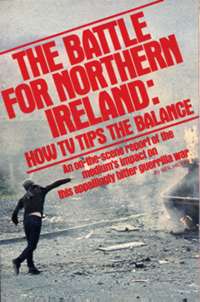
"The Battle for Northern
Ireland: How TV Tips the Balance" by Neil Hickey
TV Guide 26 Sept. - 2
Oct. 1981, 26
"The current issue of TV Guide…this week bears as its cover story 'The
Battle for Northern Ireland-How TV Tips the Balance.' Several aspects
of the article more than merit our attention. For the article (while not
one-sidely favorable) details not only the means both subtle and blunt
by which our news of Ireland had been distorted and censored prior to
the hunger strike breakthrough, but also provides direct admission by
no less an authority than the British government's chief propaganda officer
in the north about the tremendous impact of the American hunger strike
support campaign against the British."
"TV Guide on Ireland"
Irish People, 3 October 1981,
4
"Far from discrediting our cause, British intransigence, which created
the hunger strike, has given us international political recognition, and
has made the cause of Irish freedom an international issue, has increased
support at home and abroad for Irish resistance, and has shown that the
oppressed nationalist people and the political prisoners are one."
Maze prisoners' statement
announcing the end of
the hunger strike
Chicago Tribune, 4 October 1981, 1-6
"When hunger striker Bobby Sands died, Northern Ireland seemed ready to tear itself apart.
Murder and mayhem ran through the streets and attracted the world's press. At one point, ABC News had seven television camera crews in Northern Ireland. Sympathy for the hunger strikers reached record levels in Ulster, In the Irish Republic, and in the United States…
Yet, with each succeeding death, the violent response was a little less,
the news coverage less, and sympathy less."
"Reagan should act
on Ulster" by Michael Kilian
Chicago Tribune, 5 October
1981, C1-23-1
"Certainly - as far as men and women of good will are concerned - the end of the hunger strike in the H-Blocks of the Maze Prison is welcome news. Arguments as to who won or lost the macabre confrontation are immaterial.
The ten men who died put their own lives on the line - no one else's.
What they achieved was that the spotlight of the world press was put on
the North. Never before was world opinion so galvanized against British
policy in the North of Ireland."
"End of the hunger
strike," Viewpoint
Irish Echo, 10 October 1981
20
"British Prime Minister Margaret Thatcher last week attacked Irish
Northern Aid by name. The attack was followed by a highly unusual front
page editorial in the London Daily Express, which attacked Mayor
Koch of New York, and the Four Horsemen of Irish-American politics, Hugh
Carey, Edward Kennedy, Daniel Moynihan and Thomas O'Neill, as well as
Irish Northern Aid. The attacks were received by Irish Northern Aid both
as an indication of the committee's impact upon the British and as an
unanticipated source of further publicity and financial support."
"Thatcher attacks INA"
Irish People, 24 October 1981,
2
"The Irish bishops denounced the hunger strike, while Irish priests buried
the hunger-strikers. (Sixty priests attended the funeral of Raymond McCreesh.)
American Catholics saw the funerals on TV followed by the paramilitary
rites of the Provisional Irish Republican Army (IRA)-the coffin draped
in the tricolor Irish flag, masked men in uniform firing shots over the
dead soldier. Rallies in support of the hunger-strikers in New York and
Washington, D.C., included priests celebrating Mass for crowds that frequently
broke into the chant 'IRA: All the way.' The press only added to the confusion."
"Northern Ireland:
A Turning Point? Hunger Strike Deaths, the Underlying Issues,
Four Different Views," by John Bank
St. Anthony's Messenger, November
1981, 21
"It appears that, far from being a peripheral issue playing to the media,
as suspected a few months ago, the seven-month-long hunger strike at Maze
Prison is pivotal in understanding the situation. It is the tip of an
iceberg of discontent."
"Northern Ireland:
A Turning Point? Hunger Strike Deaths, the Underlying Issues,
Four Different Views," by John Bank
St. Anthony's Messenger, November
1981, 22