









General
"The Irish-American community obviously identifies with one side of our
community…There are a great many sentimental ties, but we must know that
there is also another tradition, which also has its fears and worries."
Dr. Jack Weir, leader
of a delegation of 10 Presbyterian clergymen who traveled to
the US to meet with prominent Irish American
leaders in an attempt to "explain that
they just have to remember there is a Protestant
community here."
Boston Globe, 30 April 1981
There was worldwide reaction to the drama unfolding in the Maze Prison. Newspapers and television and radio newscasts reported extensively on the story.
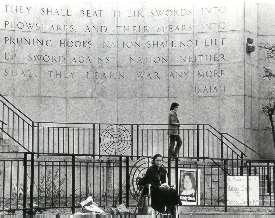 AIA Dig. ID 0001PL01 |
Terence Cardinal Cooke, many members of the U.S. Congress and church and labor leaders called on Mrs. Thatcher to grant Mr. Sands' demands in the name of peace.
In Washington, Father Sean McManus, national director of the Irish National Caucus, went on a fast outside the British consulate to dramatize the plight of Bobby Sands and to urge the British not to let him die.
In New York, a teaching nun, Sister Rosaleen Halloran, fasted outside the United Nations in sympathy with Mr. Sands.
Protest marches were held in many U.S. cities in support of the hunger
strikers."
Irish Echo, 2 May 1981
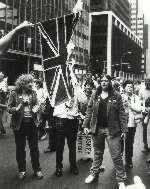
"More than 500 people, many of them members of Irish-American groups,
demonstrated outside the British consulate in New York yesterday in a
show of solidarity with Mr. Sands. The demonstration included the burning
of Prime Minister Margaret Thatcher in effigy."
New York Times,
3 May 1981, 4
"The 300 to 400 demonstrators paraded for more than an hour in front
of a British Airways office on Fifth Avenue before moving to St. Patrick's
Cathedral for a prayer vigil. Outside the cathedral, with fists raised,
the crowd sang, "A Nation Once Again," a song favored by supporters of
a unified Ireland, before praying in silence and listening to the Rev.
Daniel Berrigan, who tried unsuccessfully to visit Mr. Sands."
New York Times,
4 May 1981
"On Saturday, May 2, the Irish Northern Aid Committee (Noraid) sponsored a demonstration in front of the British Consulate in support of Bobby Sands and his fellow hunger strikers and to raise funds to counter what they termed 'the pro-British biased shown by some sections of the communications media in America when reporting on Irish affairs.'
 AIA Dig. ID 0002PL01 |
|
'We are pleased with the turnout here and across the country.' [Martin] Galvin, [official spokesman for Noraid] said. 'There are large demonstrations in San Francisco, Philadelphia and Boston. Margaret Thatcher has succeeded in uniting the Irish in America behind the hunger strikers and against what her rule represents.'…
Outside the British Consulate in New York the demonstrators were vociferous, but orderly. There was anger in their voices, mixed with a sense of "urgency," as chant leaders shouted "Bobby Sands," "Patsy O'Hara," "Frankie Hughes," "Ray McCreesh," the names of the hunger strikers, into a sound system. The marchers responded "Must not die" in cadence…
An English flag and a mannequin representing Margaret Thatcher of Britain, with a sign reading, "Monster Thatcher Wanted for Murder of Irish People" hung on it, were burned by the demonstrators…
As the final act of the protest march, the crowd, many of them kneeling,
prayed together on Hammerskold Plaza. Only the flapping of the American
and Irish flags in the breeze disturbed the voices saying the rosary.
"
"Noraid Pickets British
Consulate in Support of Sands" by Kevin McCormick
Irish Echo, 9 May 1981
"We ask that you face the future with a measure of the determination
and commitment which the hunger strikers in the H-Blocks are demonstrating.
We ask that you stand by the hunger strikers in their hour of need. We
ask that you stand by Ireland in her hour of need. According to your response,
you will either be lauded or castigated when this chapter of history comes
to be written. We have every confidence that our Irish-American friends
will not be found wanting. Your track record to date has indicated a compassionate
concern, and passionate interest in the well-being of Ireland, and of
the Irish People, and of the struggle for freedom."
"Republican prisoners
of war (with political status) incarcerated in the Cages of Long Kesh,
to our friends in Noraid, and all
concerned Irish-Americans."
"Letter from Long Kesh"
Irish People, 6 June 1981,
1
"Seven women and a young man were arrested for trespassing at the
Irish Consulate on Market Street yesterday after demanding for an hour
that their statement in behalf of prisoners in Belfast be transmitted
immediately to the government of Ireland."
"Protest at Irish Consulate"
San Francisco Chronicle, 21
July 1981, 1-2-1
 AIA Dig. ID 0023PL01 |
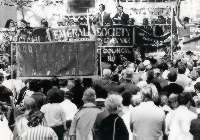
"On Fifth Ave in Manhattan yesterday, there were about 500 people who
came to a rally against the British policy in Northern Ireland. They stood
in a light rain and heard speeches and applauded and meant well, but there
were still only 500 of them. Their presence did more to point out the
disappearance of the Irish in America than it did to provoke outrage against
the British."
"Life's gone out
of Irish in America, too" by
Jimmy Breslin
Daily News, 9 August 1981,
4
"On Saturday, the New York Irish community celebrated its first
Annual Solidarity Day as more than 2,000 demonstrators gathered under
the shading trees at Dag Hammarskjold Plaza, a stone's throw from the
United Nations, to listen to labor organizers and political leaders, including
New York City's Mayor Edward I. Koch, univocally denounced the continued
British presence in northern Ireland's six plastic-bulleted counties."
"Mayor Koch Leads Protest"
Irish People, 3 October 1981
"British Prime Minister Margaret Thatcher last week attacked Irish Northern
Aid by name. The attack was followed by a highly unusual front page editorial
in the London Daily Express, which attacked Mayor Koch of New York,
and the Four Horsemen of Irish-American politics, Hugh Carey, Edward Kennedy,
Daniel Moynihan and Thomas O'Neill, as well as Irish Northern Aid. The
attacks were received by Irish Northern Aid both as an indication of the
committee's impact upon the British and as an unanticipated source of
further publicity and financial support."
"Thatcher Attacks INA"
Irish People, 24 October 1981,
1
"On Friday, the sixth of November, President Ronald Reagan will come
to New York. His intended purpose is to receive an award from the posh
American-Irish Historical Society. However, the British and particularly
Prime Minister Margaret Thatcher have exerted intense pressure to divert
this presidential visit towards a different and more sinister end. It
is their hope, and their plan, to manipulate our president into assuming
the role of British propagandist by attacking the dependents of Irish
political prisoners through an attack on Irish Northern Aid."
"Reagan's Visit," Editorial
Irish People, 7 November 1981,
4