









|
Columns |
Columns: August - October
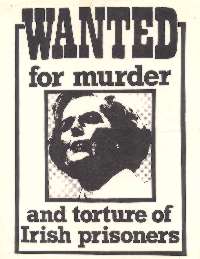 AIA Dig ID 0018PL02 |
|
"In three months, Mrs. Thatcher has done more to advance the cause of the IRA than the IRA has ever managed on its own behalf. Its response to her inflexibility - a conveyor belt of death churning out the bodies of the eager dead with what has almost come to be monotonous regularity - has altered both the nature and the context of the situation. It has allowed the IRA to usurp the moral high ground.
First, the string of deaths has gone a long way toward humanizing the IRA…Second, the deaths have allowed the IRA to reestablish itself in the heroic mold and to reaffirm its legitimacy in a historical context…Third, the deaths have allowed the IRA to redefine the conflict on its own terms…Fourth, the deaths have slowly become the catalyst for unleashing the latent anti-British sentiments that lurk just below the surface of the Irish national psyche.
In Ireland the center is in danger of collapsing. The voices of moderation
are mute. Madness has taken hold. The frenzies bewilder. In the words
of Yeats, 'monstrous familiar images swim to the mind's eye.' They are
blackmailing us, relentlessly, ruthlessly, perhaps even lovingly, and
Mrs. Thatcher, may God forgive her, is their bagman."
"Martyrdom works for
the IRA" by Padraig O'Malley
Chicago Tribune, 5 August
1981, 1-23-4-C
"The IRA is a terrorist organization, which, in its battle to unite Ulster with the Irish Republic, has killed Catholic and Protestant, soldier and civilian alike. The IRA deserves no sympathy. In the negotiations held by the Roman Catholic Churches' Irish Commission for Justice and Peace last month, both sides made large concessions in their demands and seemed to be making real progress toward accommodation. Once again, the IRA's tactics have succeeded in blocking an agreement. The stiff, rather unimaginative response by the British authorities has not been helpful either.
Hunger strikes and the violence they have spawned are not a valid reason
to delay serious negotiations toward a solution to the tragedy in Northern
Ireland. Such a solution cannot, as Protestant leaders wish, continue
the present system of discrimination against the Ulster Catholics. Nor
can it reflect the IRA's wish of uniting the North with the Republic of
Ireland against the wishes of the Protestants, who are the majority of
Northern Ireland's people."
"Irish Tragedies"
Washington Post, 5 August
1981, A22
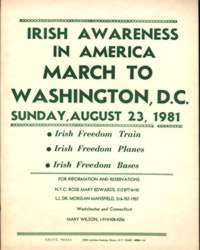 AIA Dig. ID 0014PL02 |
"Even as London prepared for its great day, and as the world's press congregated for an event that rates more exposure worldwide than a Presidential inauguration or a papal election, the last hours of those two young lives were ebbing away.
The two events occur within a few days of each other, the deaths and
the wedding. Never could the most insane philosopher devise such a theoretical
model to show the essential division between two neighboring islands,
nations which should be more closely united in the interests of both but
which instead seem destined to be pulled further apart by events which
only one really has the power to alter."
"One nation's wedding
and another's funerals"
by John A. Kelly
Irish Echo, 8 August 1981,
2
"Owen Carron's recent election to the Westminister constituency left vacant by the death of Bobby Sands has confirmed a dramatic shift in popular sympathy towards the Provisional IRA and other militant republican organizations. The shift, which is mainly due to the hunger-strike and how the British have handled-or mishandled-it, has established militant republicans as politically credible.
The fact that the hunger-strikers have shown themselves prepared to die, under horrible circumstances, has given the republicans a moral credibility that has already been translated into political support. By voting for Sands (although not because he was an IRA man) the Catholics of Fermanagh and South Tyrone showed that they recognized the sacrifice he was making, and the cause for which he made it, as being above the tactics used by his organization.
In the end, however, the organization itself benefits inevitably when
its members demonstrate such determination and courage. This shows up
in votes."
"The Provisionals growing
political authority," Analysis by Jack Holland
Irish Echo, 5 September 1981
"The hunger strike is over and now Mrs. Thatcher will grant many of the concessions she refused to grant to the strikers when some of them were dying. Her minion in Ireland, James Prior, boasts about sticking to principles, and says that now the strikers have been "defeated" that he will talk about making some changes.
The British Government's behavior now is typical of British behavior over the centuries - always making concessions when it was too late to gain them any good will in Ireland. Always too little and too late. Does Maggie Thatcher really think that even if she gave in now to all five demands that this would do anything to lessen the ferocious hatred the Catholic community in the North has for her? She is a fool if she does.
Instead of boasting about principles and about defeats, the British would
do well to think about leaving Ulster. Otherwise they may very well learn
the real meaning of defeat and be forced to go, principles or no principles."
"Once again, the concessions
come late," Campbell's Scoop by Patrick Campbell
Irish Echo, 17 October 1981,
17
"During the seven months of the hunger strike,
10 Provisional IRA prisoners died; 64 people were killed outside Maze
Prison in strife-related incidents. These tragedies sparked renewed violence
in Northern Ireland. Americans struggling to piece together the picture
need to see the strife-torn country from several different perspectives
and to realize that the issues come in shades of gray."
"Northern Ireland:
A Turning Point? Hunger Strike Deaths, the Underlying Issues,
Four Different Views," by John Bank
St. Anthony's Messenger, November
1981, 20